Wednesday, July 23, 2014

Fruit Fish-stick Train

The five year old mind is a wonder...
(of course he ate it afterwards!)


2 fish stick base with half strawberry, blueberries, and grapes

Tomatoes, Swimming, and Learning

I transferred some tomatoes that we'd grown from seeds to the backyard.  They sat there without growing for what seemed like weeks.  Now, all of a sudden, they've grown a couple of feet in the past couple of weeks!

Isabelle has been taking swim lessons on and off for years.  Now, this week, all of a sudden, she is breathing to the side, learning to dive, and just generally actually starting to swim.

"Mr. Rideout - I don't get it." "Mr. Rideout, this is too hard!" and then, at the end of the year, "Oh, I really thought that stuff we did at the beginning of the year was easy!"

I'm told the tomatoes are working on their roots, out of sight, underground for those first couple of weeks.  Then, when they're ready with their root structure, they shoot up above ground.  Is this why teaching and learning is so hard?  So much unrewarding (for both student and teacher) laying down of roots?

Thursday, May 22, 2014

My son may be a muppet

Chongers did his piano recital first and this video picks up with him hopping off the stage.  Then Isabelle performs (very nicely!), but Sebastien is the star of the show:

http://www.chrislyonsphotography.com/misslily/h323b659e#h323b659e

Saturday, May 10, 2014

One Note to Bind Them All

I've been teaching about standing waves and their connection to music for years. But I recently discovered I haven't been making the connection explicit enough.  For instance, in a recent class when I remarked "See, that relationship between math and music is for real!", a student then responded "You mean the rhythm?"  But I was talking about pitch!

For standing waves:


Even though a note is identified by the fundamental frequency (the largest wave pictured above), it will have many higher harmonics buried within.  It is this distribution of higher harmonics (all obeying the mathematical relationship: Frequency of higher harmonic = N * Frequency of the fundamental), that give a musical note its timbre or unique sound.  It allows us to distinguish a middle A played on trumpet from the same note played on a piano.

Let's run some numbers.  If a string tuned to be a very low pitched "A" is plucked it will vibrate at all of the following frequencies:

N Frequency
1 55
2 110
3 165
4 220
5 275
6 330
7 385
8 440
9 495
10 550

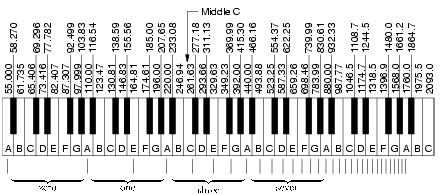
Compare this to the frequency of musical notes:
 Note that every octave is a frequency doubling.  So our low pitched A string actually contains all of the higher octaves within (N=2, N=4, N=8). What about the other harmonics? N=3, N= 6 are both the note "E".  A and E are perfect "fifths". Also, the N=5 is close to  C#.  Wait a sec!  A- C# - E; isn't that the A major chord??

Let's do another.  Take a string tuned to a low "C".  The first few harmonics would be:

N Frequency
1 65.406
2 130.812
3 196.218
4 261.624
5 327.03
6 392.436
7 457.842
8 523.248
9 588.654
10 654.06
 N= 3 is a "G", N=5 is very close to "E"  C-E-G:  the classic C major chord!

The complete major chord is already contained within the first note and relationship between the musical notes is, just like everything in this universe, all about the physics!

Thanks to student KO for staying after and helping me investigate the perfect 5th relationship between the tuning fork held far from the ear and then close to the ear which led to this post.


Sunday, March 30, 2014

Powers of Two

  Friday afternoon, my students are taking a test and I check my school email.  The Tech department sent out a URL for us to consider blocking in our classroom because the students are playing some kind of addictive game.
  You know what I'm thinking at this point, right?  I promptly surf over to the site and start playing the game.  Gotta check out what the student are up to these days, right?


Do you think the exams were graded super-fast? Well, I had an important weekend project...

Saturday, March 22, 2014

Saturday Conversation at the Rideouts

Isabelle (2nd grade):  "Daddy, tell me again about the multiverses and how there could be other universes?"
Me: "Well, everything we can currently or will ever be able to see is the Universe, but there are (or could be) other universes out there but we'll never have any evidence for it."
Isabelle: "Then it's not really science, is it?  It's just an idea."
Me: "True, but the idea of multiverses is consistent with the science we do know."
Isabelle: "But why would you say we'll never be able to see something far away? If we wait long enough, won't the light eventually get here?"
Me: "Good point, but the universe is expanding so the distant objects are actually getting more distant all the time"
Isabelle: "But the light it emits now, before it moves away, will still get to us eventually, right?"
Me (starting to sweat): "Yes it seems that way, but it's actually the space between us that is expanding and so that makes it hard for the light to get to us."
Isabelle: "Expanding faster than the speed of light?  I don't understand that"
Me: "Um, yes, well, if the object is really far away then there is a lot of space and every piece of it is expanding, then the object could actually be moving away from us faster than the speed of light."
Isabelle: "But the light should still get to us!"
Me: "But the light is traveling through space that is expanding too, so it's like the light is running towards us while the floor itself is getting bigger and it's as if the light is running in place."
Isabelle: "I don't get it"
Me: "Me neither."(thinking: maybe I shouldn't show her any more episodes of Cosmos)

Wednesday, March 19, 2014

Those Who Can't Do...

... Teach.

I once said this to a math teacher when I was a high school student.  I hope he knows that I am now a teacher and savoring the irony.  I didn't mean it maliciously, but I did say it.  I've been thinking about that moment a lot recently.

Just the other day I said to a colleague only partly in jest, "I used to have such a high aspirations for myself - now look at me!"  He looked at me a bit incredulously and said "What could be more important than the work you do now?"  I guess part of me agrees but another part of me can't help but compare where I am now to where I thought I would be so long ago (perhaps a writer, a scientist, or, better yet, both!).

Validation comes in many forms but one of the best is the years-later thank you.  I've been teaching for 12 years now which means that my former students are doing all kinds of things.  Some are research scientists, some are switching careers or going back to school, some have even become (*gulp*) physics teachers.  One of the many perks of this great job is when you get an email, letter, or shout out of some kind from a former student who is now an adult and feels that I had some positive influence way back when.  (I'd like to give a special shout-out to DK who recently wrote a really great story/letter to me that got me thinking about this stuff.)  Clearly these people are delusional, but I take it all at face value and, puffing out my chest, turn back into the (classroom) fray to push back the tides of darkness.

Funny how life is full of twists and turns.  I never even considered teaching as a career until I was in my 30's.  Turns out to be the job I've enjoyed the most and, just maybe, the most important one I could have aspired to...

Someday when I grow up, maybe I'll send a shout out back to my former teachers, I bet they'd like that!