
Friday, August 22, 2014
Presbyopia
Something funny happened on my way to a monocle...I got old. I really noticed this when reading out the names at last spring's award ceremonies - turns out when the paper you're reading is on a podium, you can't just extend your arms to bring everything into focus...


Am I Buying a Fish or Teaching Myself to Fish?
My friend, GG, would be proud. Last year I paid a chimney sweep a ton of money to sweep out all the chimneys (probably hadn't been done in 5 years). I watched him carefully, bought myself a brush for $25 and did the wood stove chimney myself this year.
Inspired by this, when Drano didn't clear up the slow draining shower this week, I ran to home depot and bought a $15 auger and snaked that pipe out myself.
Now, what I'm not telling you about is the burst pipe and the disassembled sink that have yet to be fixed, but 2 out of 4 ain't bad, right? Oh, and the yard is over-run with weeds. Let's focus on the positive, people!
Why exactly is home ownership part of the American Dream, again?
Wednesday, July 23, 2014
The stormtrooper-fruit link
I just read a science fiction book where the protagonist has a genetic anomaly that makes her unique. The details aren't important but some aliens at one point clone her so they can use the clones (and their abilities) to their own ends.
How bizarre, no?
No.
I think that almost all of the fruit we eat have been grafted from a single plant from the past that was uniquely tasty or uniquely resistant to disease. We keep grafting or budding over and over and raising these genetically identical fruit. Clones, actually.
Next time you are in the supermarket look at all those bananas and think about that...

How bizarre, no?
No.
I think that almost all of the fruit we eat have been grafted from a single plant from the past that was uniquely tasty or uniquely resistant to disease. We keep grafting or budding over and over and raising these genetically identical fruit. Clones, actually.
Next time you are in the supermarket look at all those bananas and think about that...
Fruit Fish-stick Train
The five year old mind is a wonder...
(of course he ate it afterwards!)
(of course he ate it afterwards!)
 |
| 2 fish stick base with half strawberry, blueberries, and grapes |
Tomatoes, Swimming, and Learning
I transferred some tomatoes that we'd grown from seeds to the backyard. They sat there without growing for what seemed like weeks. Now, all of a sudden, they've grown a couple of feet in the past couple of weeks!
Isabelle has been taking swim lessons on and off for years. Now, this week, all of a sudden, she is breathing to the side, learning to dive, and just generally actually starting to swim.
"Mr. Rideout - I don't get it." "Mr. Rideout, this is too hard!" and then, at the end of the year, "Oh, I really thought that stuff we did at the beginning of the year was easy!"
I'm told the tomatoes are working on their roots, out of sight, underground for those first couple of weeks. Then, when they're ready with their root structure, they shoot up above ground. Is this why teaching and learning is so hard? So much unrewarding (for both student and teacher) laying down of roots?
Thursday, May 22, 2014
My son may be a muppet
Chongers did his piano recital first and this video picks up with him hopping off the stage. Then Isabelle performs (very nicely!), but Sebastien is the star of the show:
http://www.chrislyonsphotography.com/misslily/h323b659e#h323b659e
http://www.chrislyonsphotography.com/misslily/h323b659e#h323b659e
Saturday, May 10, 2014
One Note to Bind Them All
I've been teaching about standing waves and their connection to music for years. But I recently discovered I haven't been making the connection explicit enough. For instance, in a recent class when I remarked "See, that relationship between math and music is for real!", a student then responded "You mean the rhythm?" But I was talking about pitch!
For standing waves:
 Even though a note is identified by the fundamental frequency (the largest wave pictured above), it will have many higher harmonics buried within. It is this distribution of higher harmonics (all obeying the mathematical relationship: Frequency of higher harmonic = N * Frequency of the fundamental), that give a musical note its timbre or unique sound. It allows us to distinguish a middle A played on trumpet from the same note played on a piano.
Let's run some numbers. If a string tuned to be a very low pitched "A" is plucked it will vibrate at all of the following frequencies:
Compare this to the frequency of musical notes:
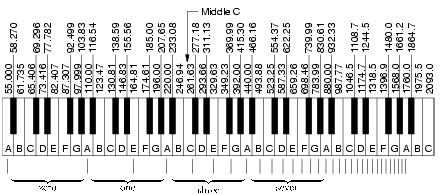 Note that every octave is a frequency doubling. So our low pitched A string actually contains all of the higher octaves within (N=2, N=4, N=8). What about the other harmonics? N=3, N= 6 are both the note "E". A and E are perfect "fifths". Also, the N=5 is close to C#. Wait a sec! A- C# - E; isn't that the A major chord??
Let's do another. Take a string tuned to a low "C". The first few harmonics would be:
N= 3 is a "G", N=5 is very close to "E" C-E-G: the classic C major chord!
The complete major chord is already contained within the first note and relationship between the musical notes is, just like everything in this universe, all about the physics!
Thanks to student KO for staying after and helping me investigate the perfect 5th relationship between the tuning fork held far from the ear and then close to the ear which led to this post.
For standing waves:
Let's run some numbers. If a string tuned to be a very low pitched "A" is plucked it will vibrate at all of the following frequencies:
| N | Frequency |
| 1 | 55 |
| 2 | 110 |
| 3 | 165 |
| 4 | 220 |
| 5 | 275 |
| 6 | 330 |
| 7 | 385 |
| 8 | 440 |
| 9 | 495 |
| 10 | 550 |
Compare this to the frequency of musical notes:
Let's do another. Take a string tuned to a low "C". The first few harmonics would be:
| N | Frequency |
| 1 | 65.406 |
| 2 | 130.812 |
| 3 | 196.218 |
| 4 | 261.624 |
| 5 | 327.03 |
| 6 | 392.436 |
| 7 | 457.842 |
| 8 | 523.248 |
| 9 | 588.654 |
| 10 | 654.06 |
The complete major chord is already contained within the first note and relationship between the musical notes is, just like everything in this universe, all about the physics!
Thanks to student KO for staying after and helping me investigate the perfect 5th relationship between the tuning fork held far from the ear and then close to the ear which led to this post.
Subscribe to:
Posts (Atom)


