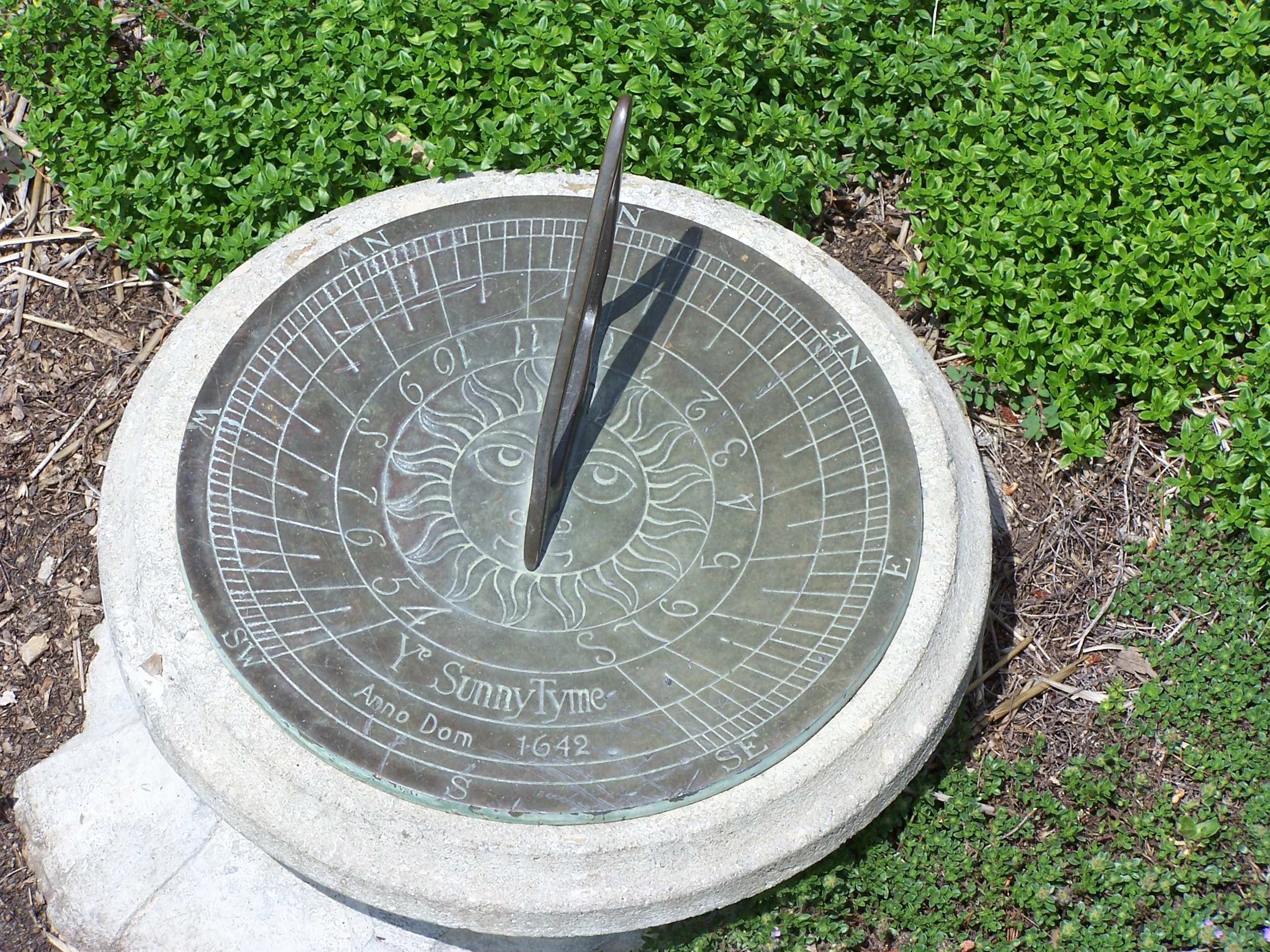
Saturday, September 3, 2011

Clocks and Northern Dominance

Clockwise and counter clockwise are common terms that come from, well, clocks. 

And those hands on the clocks move that way because... the shadows in a sundial turn that way! 

However, sundials in the southern hemisphere have noon pointing south and the shadow moves counter clockwise as you look down on them.  Once again, something we all take for granted as fundamental is just an accident of fate (northern hemisphere folk invented the first clocks and watches I suppose and thus got to determine "clockwise" and "counter clock wise" for all time thereafter).

Wednesday, August 24, 2011

Divided on Scallops

When I was little, I often thought things in France were uniquely French and had nothing to do with the things I knew in America.

For example, in the U.S., I knew I liked scallops:


In France, I had a different favorite:  the coquille Saint-Jacques.  When I grew older someone told me they were the same thing.  But how could they be when in France they were always tinged orange at one end and in America they were always all-white?


I admit to just living with the mystery (until today), enjoying both depending on which country I was in.  Today, though, I discovered that in America, we systematically separate out the roe to leave only the white muscle part whereas in France they systematically leave both the muscle and roe attached!


This is what a scallop looks like if you slice it open fresh out of the ocean:
Why didn't I even figure this out before?  My brain never seemed to try to integrate french-experience with american experience until after my 20's - before then, I was simply two slightly different people...

Ken, meet Ken and get it together, man!


Monday, August 22, 2011

Butterfly Spirit

Listen carefully, kids!
At the Smithsonian - Butterflies landed on me three times, much to the kids amusement!
"Once, I, Chang Tzu, dreamed that I was a butterfly and was happy as a butterfly. I was conscious that I was quite pleased with myself but I did not know that I was Tzu. Suddenly I awoke and there I was, visible Tzu. I do not know whether it was Tzu dreaming that he was a butterfly or the butterfly dreaming that it was Tzu."
Chang-Tzu, III - II a.C., Chinese philosopher, Book of Chang-Tzu 

Thursday, August 11, 2011

Star Wars and Your Inner Struggle with Good and Evil

Check out this artwork by a nephew of mine who is around 5 years old:


Our hero is fighting our villain.  But the hero IS the villain!  This kid is deep - wise beyond his years.

Monday, August 8, 2011

Beer Brewing

Years ago, Irene had asked me if I was interested in doing some home wine-making.  Very haughtily I replied "Certainly not!"  (C'mon, I used to make wine 1000's of gallons at a time from the grape, how could I reduce myself to making 2 or 3 gallons from a grape concentrate?).

***years pass***

I was driving around a bit randomly on Father's Day with Sebastien and we saw a "Beer and Wine Hobby Shop".  And I thought "hmmm... I'm not so snobby about beer-making as I am about wine-making."  (Who talks about the quality of the barley harvest that year?).  So I asked Sebastien if he wanted to buy Daddy a nice father's day gift and he said "Yes!"

So here are the details of my first trial run (following a recipe for "A Dark Beer" supplied with the kit):

1.  The kit brews 5 gallons a shot, so you need a lot of bottles.  And those bottles need to be clean:

2.  Next you've got to extract some body and color from some specially prepared malted barley ("Crystal malt") ("mashed" is the technical term for what has happened to the barley:  heating the germinated barley to convert some starch to sugar and soaking it to extract the good stuff)
In front of the pot you see a white bag that contains the malted barley
3.  Now, in goes the hops (flowers added to beer for taste and their preservative properties) and the syrupy malt extract (malted barley extract - malted barley is just germinated barley that has been dried).  Grains should be germinated a bit in order to be able to convert their starches into sugars. (need the right enzymes)
This goop is called the "wort"
4.  Add enough water to get up to 5 gallons total and then add some yeast ("pitching" the yeast).  Yeast is a type of fungus that eats sugar and makes carbon dioxide and alcohol
C6H12O6   ====>   2(CH3CH2OH)  +  2(CO2) . 
The mixture then foamed and had a lot of activity as the yeast reproduced and generations of those little guys lived the good life in that vat.  After 3 days I decided to separate the fermenting brew from the yeast sediment ("racking" the beer). 
siphoning from the primary fermentation bucket into a glass one


Note all the sediment left behind by all the fermentation activity.  Vegemite, anyone?


Outgassing of the carbon dioxide via the fermentation lock on the top of the primary fermentation bucket.


5. A few more days and the beer was done fermenting.  No more bubbles of CO2 visible and the density of the liquid was stable for 3 days.  The density of the wort is higher than water in the beginning (1.088 kg/liter in my case) and lower when finished fermenting (1.022 kg/liter for me).  One sugar molecule is heavier than two alcohol molecules so the mixture become less dense while fermenting.  The difference in density (0.066) gives me an approximate alcohol content of 3 percent for my final beer.
 7.Time to bottle.  Add a bit more sugar to the beer and then line up the clean bottles, the new caps and the capper:
Nice bald spot, Dad!
6.  Two more week for secondary fermentation in the bottle.  This will give the bottled beer some natural carbonation (just like how they do it with champagne!) and we have produced our first home-made beer:
The in-bottle fermentation leaves a little sediment in the bottle. Commercial brewers force carbonate their beer like soda pop to avoid this.

Special thanks to Isabelle for all her help!

Follow Up:

For a subsequent Father's Day, Irene (with some help from Eugene) made me some labels:


Sunday, July 17, 2011

Me Caveman

While on vacation this month, we visited the Smithsonian in DC.  In the human evolution exhibit, there was a display of a human face morphing into a prehistorical ancestor's face.  Turns out there is a free ipad app that does this!  So here I am as caveman ancient and caveman super-ancient:

(the app just keeps your eyes and mouth and uses the same picture for the rest)

More on Rainbows

In earlier post, I talked about the questionable nature of the "7 colors of the rainbows".   But I failed to talk about why the bands of colors are uneven, never mind how many there actually are.  In the picture below I have overlayed an enlarged picture of a real rainbow and a graph of the sensitivities of our three cones.  As you can see, the narrow sharpness of yellow and the wide blending of blue into violet and red into orange come from the ranges over which the individual cones are sensitive!

There is some evidence that a few women (need two X chromosomes for this theory to work) are born with four kind of cones (like most birds!) and can discriminate even more bands of colors that the rest of us.
Dogs, on the other hand, only have two types of cones and so are partially color blind.